
You are here
 Acarosporaceae (1)
- Arthoniaceae (1)
- Arthoniomycetes (1)
- Caliciaceae (2)
- Cladoniaceae (1)
- Coccocarpiaceae (1)
- Coenogoniaceae (1)
- Crocyniaceae (1)
- Dictyonema (2)
- Ectolechiaceae (3)
- Eremithallus (1)
- Eurotiomycetes (2)
- Gomphillaceae (4)
 Graphidaceae (8)
- Icmadophilaceae (1)
- Lecanoraceae (3)
- Lecanoromycetes (9)
- Lecideaceae (1)
- Lichinales (1)
- Lobariaceae (2)
- Megalosporaceae (1)
- Megasporaceae (1)
- Ochrolechiaceae (1)
- Pannariaceae (1)
- Parmeliaceae (8)
- Pertusariaceae (1)
- Phlyctidaceae (1)
- Pilocarpaceae (2)
- Porinaceae (1)
- Pyrenulaceae (1)
- Ramalinaceae (4)
- Rhizocarpaceae (1)
- Roccellaceae (3)
- Sphaerophoraceae (1)
- Stereocaulaceae (1)
- Teloschistaceae (2)
- Thelotremataceae (3)
- Trapeliaceae (1)
- Verrucariaceae (1)

Fissurina nigrolabiata Rivas Plata, Bawingan & Lücking
Nomenclature
-
Family: GraphidaceaeGenus: Fissurina


SUMMARY
Mycobank MB 517772
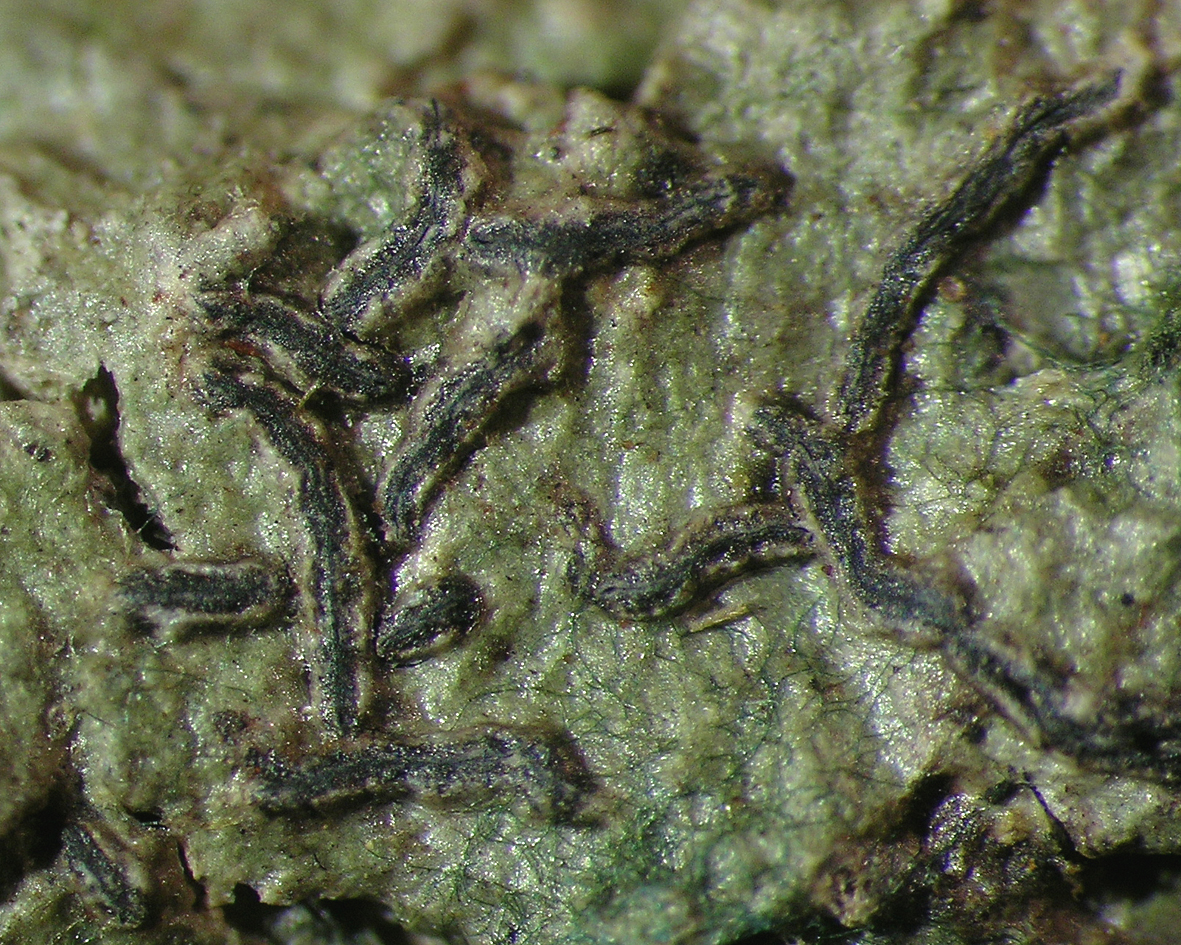
Thallus corticolous, 3–5 cm diam., 30–50 µm thick, continuous; surface smooth to uneven, green, shiny. Thallus in section with prosoplectenchymatous upper cortex, irregular algal layer and large clusters of crystals. Lirellae straight to curved, unbranched to sparsely branched, erumpent to prominent, with well-developed labia, with lateral thalline margin, 1–3 mm long, 0.3–0.4 mm wide, 0.3–0.4 mm high; disc concealed; labia conspicuous, thickened, greyish black to brown-black, apically covered by translucent cortical layer; thalline margin cream-colored, sometimes with slight redding tinge. Excipulum entire, completely and massively carbonized including below the hypothecion, black, 80–120 µm wide laterally and up to 200 µm thick below; laterally covered by corticate algiferous thallus including large clusters of crystals at the base; hypothecium prosoplectenchymatous, 5–10 µm high, colourless to pale yellowish; hymenium 120–180 µm high, colourless, clear; epithecium indistinct. Paraphyses unbranched, glabrous; periphysoids not observed; asci fusiform, 80–100 x 15–20 µm. Ascospores 8 per ascus, ellipsoid, muriform with 3–5 x 1–2 septa, 12–17 x 5–8 µm, with comparatively thin outer wall, 2–2.5 times as long as wide, I–. Secondary chemistry: no substances detected by TLC.