
You are here
 Acarosporaceae (1)
- Arthoniaceae (1)
- Arthoniomycetes (1)
- Caliciaceae (2)
- Cladoniaceae (1)
- Coccocarpiaceae (1)
- Coenogoniaceae (1)
- Crocyniaceae (1)
- Dictyonema (2)
- Ectolechiaceae (3)
- Eremithallus (1)
- Eurotiomycetes (2)
- Gomphillaceae (4)
- Graphidaceae (8)
- Icmadophilaceae (1)
- Lecanoraceae (3)
- Lecanoromycetes (9)
- Lecideaceae (1)
- Lichinales (1)
- Lobariaceae (2)
- Megalosporaceae (1)
- Megasporaceae (1)
- Ochrolechiaceae (1)
- Pannariaceae (1)
- Parmeliaceae (8)
- Pertusariaceae (1)
- Phlyctidaceae (1)
- Pilocarpaceae (2)
- Porinaceae (1)
- Pyrenulaceae (1)
- Ramalinaceae (4)
- Rhizocarpaceae (1)
- Roccellaceae (3)
- Sphaerophoraceae (1)
 Stereocaulaceae (1)
- Teloschistaceae (2)
- Thelotremataceae (3)
- Trapeliaceae (1)
- Verrucariaceae (1)

Lepraria sekikaica Elix
Nomenclature
-
Family: StereocaulaceaeGenus: Lepraria
Media


SUMMARY
Mycobank MB 517795
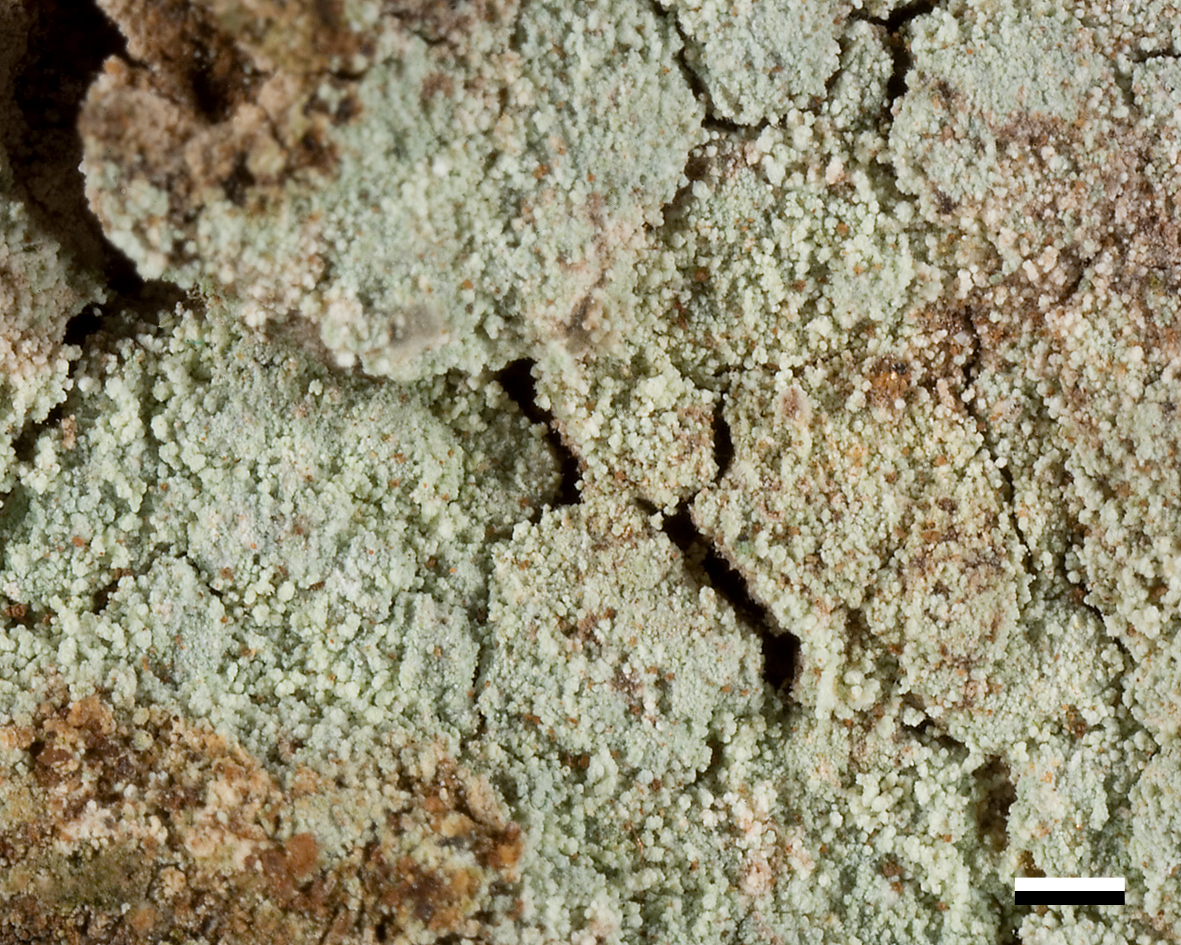
Thallus leprose-sorediate, powdery, creamy white, grey-white, pale yellow-grey or brownish grey, forming extensive, irregularly spreading patches to 10 cm wide, or in small, irregularly roundish, colonies 0.5–2 cm wide that eventually coalesce; not delimited, well-defined lobes absent but sublobes often present, 0.4–1.0 mm wide, compacted at the margins; thin or thick (up to 250 µm thick), medulla absent; hyphae 1.0–2.5 µm thick; granules (soredia) farinose, dispersed or forming a thick, continuous layer, ± roundish, 15–40 µm wide, commonly aggregated in roundish to irregular clumps (consoredia) 100–200 µm wide; rarely with short projecting hyphae (10–20 µm long) but usually not apparent; photobiont chlorococcoid, more or less spherical, with individual cell 6–13 µm diam. Hypothallus thin, dispersed, pale brown to white or orange-brown in part, sometimes not apparent. Secondary chemistry: atranorin (minor), sekikaic acid (major), homosekikaic acid (minor), 4'-O-demethylsekikaic acid (minor), fragilin (minor), ± di-O-methylstrepsilin (trace); thallus K+ yellow, C–, KC–, P+ pale yellow.