
You are here
 Acarosporaceae (1)
- Arthoniaceae (1)
- Arthoniomycetes (1)
- Caliciaceae (2)
- Cladoniaceae (1)
- Coccocarpiaceae (1)
- Coenogoniaceae (1)
- Crocyniaceae (1)
- Dictyonema (2)
- Ectolechiaceae (3)
- Eremithallus (1)
- Eurotiomycetes (2)
- Gomphillaceae (4)
- Graphidaceae (8)
- Icmadophilaceae (1)
- Lecanoraceae (3)
- Lecanoromycetes (9)
- Lecideaceae (1)
- Lichinales (1)
- Lobariaceae (2)
- Megalosporaceae (1)
- Megasporaceae (1)
- Ochrolechiaceae (1)
- Pannariaceae (1)
 Parmeliaceae (8)
- Everniastrum (1)
- Hypogymnia (1)
- Hypotrachyna (6)
- Menegazzia (1)
- Parmelia (1)
- Platismatia (1)
- Relicina (1)
- Usnea (2)
- Pertusariaceae (1)
- Phlyctidaceae (1)
- Pilocarpaceae (2)
- Porinaceae (1)
- Pyrenulaceae (1)
- Ramalinaceae (4)
- Rhizocarpaceae (1)
- Roccellaceae (3)
- Sphaerophoraceae (1)
- Stereocaulaceae (1)
- Teloschistaceae (2)
- Thelotremataceae (3)
- Trapeliaceae (1)
- Verrucariaceae (1)

Menegazzia endocrocea Kantvilas
Nomenclature
-
Family: ParmeliaceaeGenus: Menegazzia


SUMMARY
Mycobank MB 517798
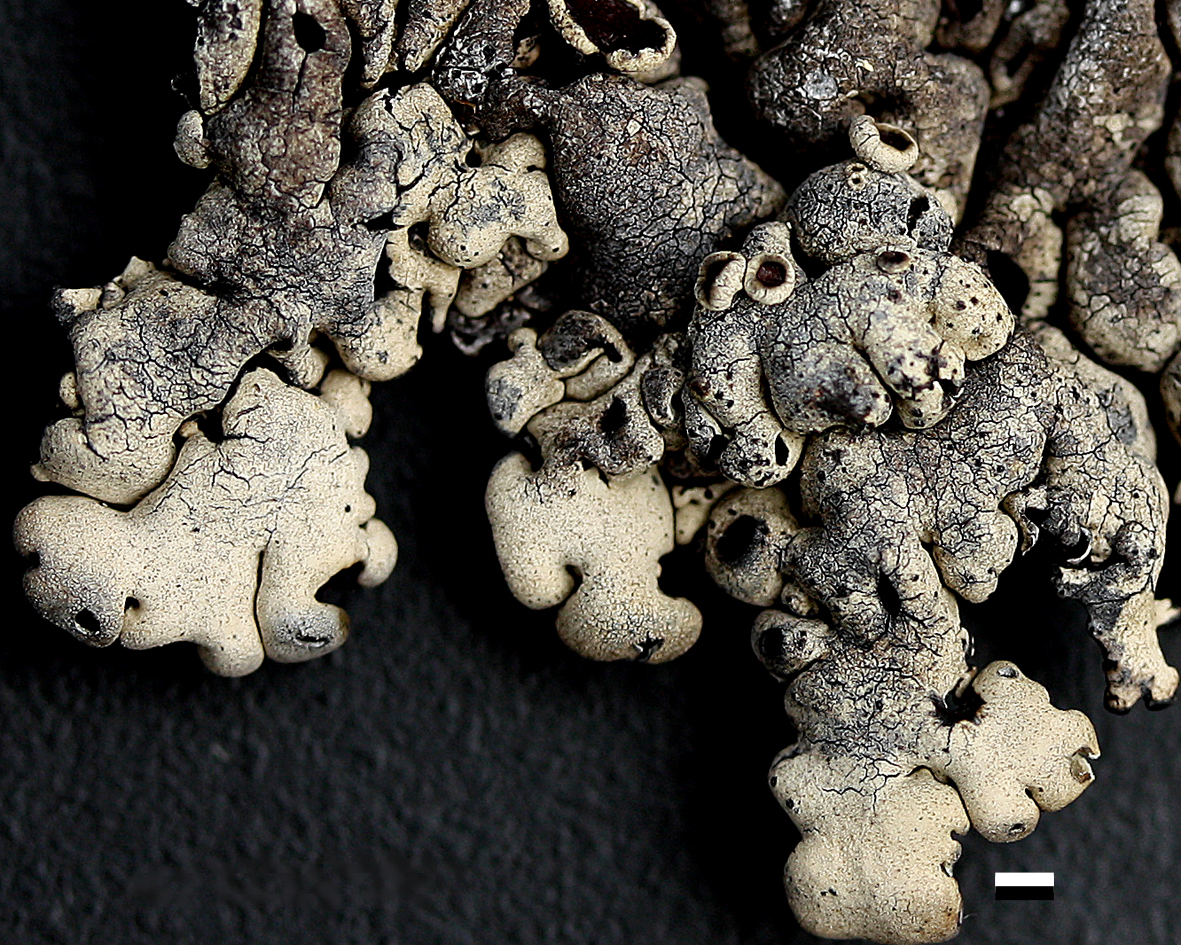
Thallus rather loosely adnate, forming irregular rosettes to 100 mm wide, or occurring as scattered, smaller clumps of lobes, lacking soredia and isidia. Lobes hollow, inflated, cylindrical, (1–)1.5–3(–4) mm wide, ± dichotomously branched, slightly constricted at the axils; central lobes densely imbricate, generally lacking secondary lobules; marginal lobes radiating, contiguous, with apices somewhat decumbent. Upper surface perforate, pale grey to cream-grey, pale brownish grey at the lobe apices, smooth, matt, often patchily discoloured blackish in older or abraded portions, lightly whitish-pruinose, especially in younger parts of the thallus. Perforations numerous, scattered, roundish to broadly ellipsoid, 0.5–1.7 mm wide, with margins usually flush to the the surface or, occasionally, raised and the perforations appearing volcano-like. Lower surface wrinkled, dull to glossy black, becoming brownish near the lobe tips. Medullary cavity black and often with a loose cobweb of whitish hyphae in older lobes, faintly pale orange in younger lobes and towards the lobe apices. Apothecia scattered, 1–4 mm wide, roundish, subpedicillate; thalline margin initially thick and inrolled, later to 0.1–0.3 mm wide, mostly smooth and entire or with occasional radial cracks and crenulations; disc reddish brown, undulate, often eroded. Hymenium 90–140 µm thick, colourless in the lower part, overlain by a reddish brown, non-granular epithecial layer 5–10 µm thick, becoming fuscous brown in KOH. Asci 2-spored, broadly ellipsoid, 80–110 x 30–55 µm, rather rarely encountered, mostly nestled deeply within a reticulum of anastomosing paraphyses 2–3 µm thick, with capitate, brown apices 3–8 µm thick. Ascospores simple, hyaline although sometimes brownish when over-mature, subglobose to broadly ellipsoid, (38–)40–51.5–66(–72) x (24–)28–34.8–44(–56) µm; wall 4–8 µm thick. Pycnidia abundant, scattered, immersed in the upper surface and evident as black specks; ostiole 0.08 mm wide; conidia fusiform, 6–8 x 1–1.2 µm. Secondary chemistry: atranorin, chloroatranorin, stictic acid, constictic acid, plus the pigment isopigmentosin A and traces of isopigmentosin B and isopigmentosin C (pigments determined by J. Elix using HPLC); cortex K+ yellow; medulla K+ yellow, KC–, C–, P+ orange, UV+ orange.